
Choosing an OTP Channel: SMS, WhatsApp, Telegram, or Email
A practical guide to choosing between SMS, WhatsApp, Telegram, and email for one-time passcodes, comparing reach, latency, and fallback strategy.
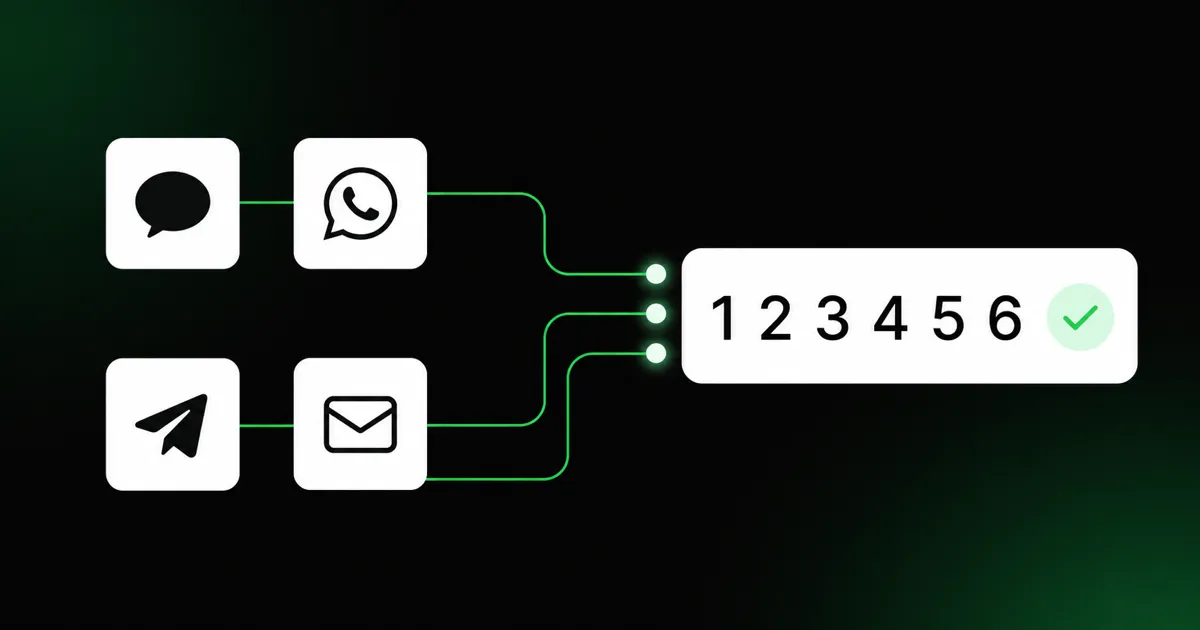
Every verification flow starts with the same question: how do we reach the user? The four mainstream options (SMS, WhatsApp, Telegram, and email) differ far more than most teams expect, and the wrong default quietly costs you conversion in entire regions.
Here is the comparison we wish we’d had when we started.
The short version
| Channel | Reach | Typical latency | Weak spot |
|---|---|---|---|
| SMS | Every phone | 2–10 s | Pumping fraud, carrier filtering |
| ~3 B users | User-driven | Extra tap to receive the code, app needed | |
| Telegram | ~1 B users | 1–3 s | Smaller reach, geo-skewed |
| Every account | 2–30 s | Spam folders, slow to open |
SMS: the default for a reason
SMS still reaches every handset on the planet without an app install, which is why it remains the default OTP channel. But it has two structural problems:
- Pumping fraud. SMS pumping can turn your signup form into someone else’s revenue stream, and the abuse is easy to trigger at scale.
- Carrier filtering. Routes degrade silently. A code that arrives in 3 seconds today can take 40 seconds tomorrow because an intermediate carrier changed.
Treat SMS as the fallback where app-based channels are available and the primary channel where messaging apps are rare.
WhatsApp: the conversion winner where it’s installed
Where WhatsApp is dominant (Latin America, India, large parts of Europe and MENA), verification
happens inside the app the user already lives in. WhatsApp differs from the other channels only
in delivery: the code is not sent with the send response. Instead the response returns an
action_url (a wa.me link) and the OTP stays pending. The user taps it, WhatsApp opens with a
prefilled message they send to your business number, and we reply over chat with their code.
The catch: the user must have the app, and there is one extra tap to receive the code. From there
it is identical to the other channels: the user enters the code and you call POST /otp/verify
(the otp.approved webhook fires on approval too).
Telegram: fast and underrated
Telegram OTPs arrive nearly instantly. Reach is the constraint, but in markets like Russia, Ukraine, Iran, and parts of Central Asia, Telegram penetration rivals or beats WhatsApp. If your user base skews technical, it’s often the best first choice.
Email: slow but always there
Email is universal, but it’s the slowest path to a six-digit code: inbox delivery can take half a minute, and the code may land in spam. Use it for low-risk flows (newsletter double opt-in, secondary device confirmation) or as the final fallback.
Reach is regional, not global
The instinct to pick “the best channel” is the mistake. There is no global best; there is only the best channel for this recipient in this country on this device. WhatsApp is the obvious first choice in São Paulo and close to useless in Seoul. Telegram is the default in Tehran and a rounding error in Toronto. The same product, shipping worldwide, needs different channel orders per market, which is why hard-coding one channel is the pattern that ages worst.
This is also why per-country tuning matters more than picking a favorite. Delivery rates for a given channel swing widely by destination, and the only way to know your numbers is to route by country and watch what actually gets through.
Latency is a distribution, not a number
The “typical latency” column above hides the part that hurts. What frustrates users is not the median; it is the tail, the p95 send that takes 30 seconds while they stare at an empty inbox and retype their number. Telegram has a tighter tail than SMS because there is no carrier chain to degrade, while SMS has the fattest tail because any hop in the route can stall. WhatsApp sits apart on this axis: its timing is user-driven, set by when the user taps the link to open WhatsApp and receive the code. If you measure one thing, measure p95 per channel per country, not the average.
Putting it together: the cascade
The right answer is rarely a single channel. A typical high-conversion cascade looks like this:
- Detect the user’s likely channels (country code, prior sessions, device hints).
- Send on the highest-reach code channel for that user: Telegram where present, SMS otherwise.
- Fall back across channels if the code isn’t used within a few seconds: a resend advances to the next channel in your order.
- Escalate to email as the tail of the chain. WhatsApp can sit at the tail only in its
Template mode; in the link modes its flow starts with the user opening a
wa.melink, so it works as the first channel and a plain resend skips it anywhere else.
The good news is that you do not have to build this branching yourself if your provider routes and falls back for you: one send call picks the channel, and a resend advances to the next one in your order without any channel logic in your code. Your job shrinks to setting the order per market and watching the results.
A well-tuned cascade improves both delivery rate and time to code in app-heavy regions. That’s the whole game: match the channel to the user, verify delivery, and never let a single carrier decide your signup conversion.