
OTP vs Passwords, Magic Links, and Passkeys
OTP is one tool among passwords, magic links, authenticator apps, and passkeys. Here is what each one proves, and when a delivered code is the right call.
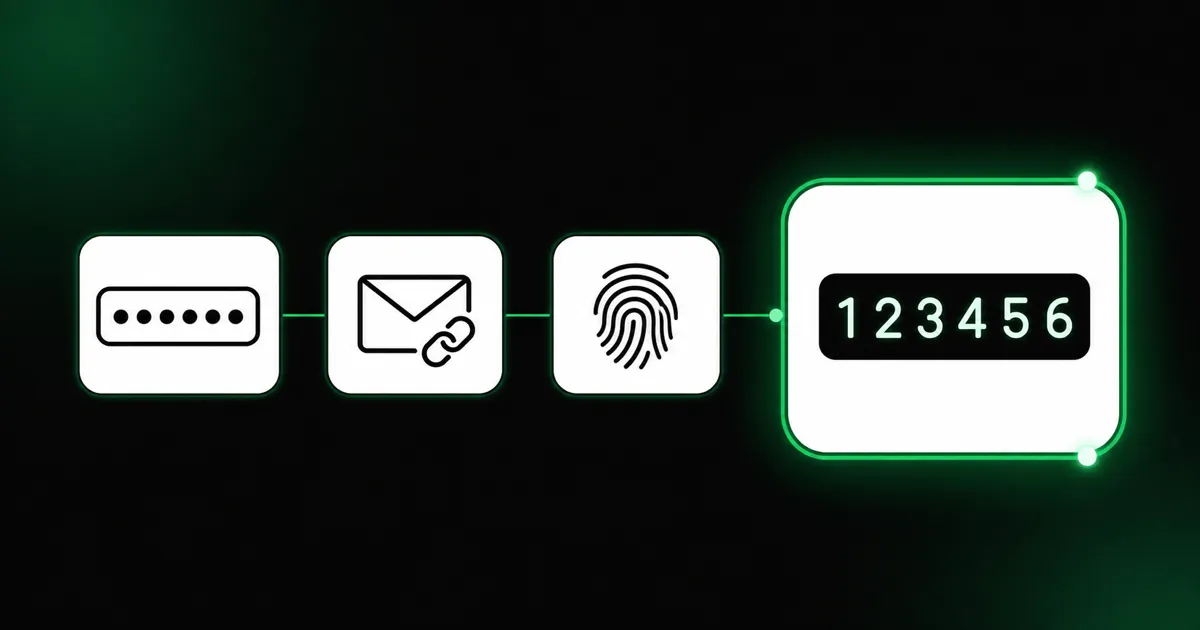
“Add OTP” is often the reflex when a product needs to verify a user. Sometimes it is exactly right. Sometimes a magic link, an authenticator app, or a passkey fits better, and reaching for a one-time passcode adds cost and friction you did not need. The way to choose is to be precise about what each method actually proves.
What an OTP proves
A one-time passcode proves possession of a channel: the person can receive a message at this phone number or this email address, right now. For SMS, Telegram, or email you send a code, the user reads it and types it back. WhatsApp works the same way with one extra tap: the user opens a chat link to receive the code over chat, then types it back. Either way it is a strong, low-friction signal for “this is the same person who owns this number,” which is why OTP dominates signup, phone or email verification, and step-up checks.
What it does not prove is long-term identity or resistance to a determined attacker who can intercept the channel. Keep that boundary in mind as you compare.
OTP vs passwords
A password proves knowledge of a secret. Its failure modes are well known: reuse across sites, phishing, and database leaks. Because the secret is stored and reused, one breach compromises every place it was used.
An OTP proves possession instead of knowledge, and the secret is single-use and short-lived, so there is nothing durable to steal or reuse. For consumer products, a delivered code is usually a better primary factor than a password, and pairing the two (password plus OTP) is the classic two-factor setup.
OTP vs magic links
A magic link is the same idea as an email OTP with a different last step: instead of reading a code and typing it, the user clicks a link that carries a token. Both prove possession of the email inbox. The trade is about flow, not security:
- A link is one tap on the device that received it, but it breaks when the link opens in a different browser than the app, and deep-linking into a native app is fiddly.
- A code works across devices: the user can receive it on a phone and type it on a laptop, which is exactly the cross-device case the entry screen handles well.
If your users routinely start on one device and finish on another, a code travels better than a link.
OTP vs authenticator apps (TOTP)
An authenticator app generates a time-based code from a secret seeded once at setup. It proves possession of that seeded device. Compared with a delivered OTP:
- No delivery step, so no carrier latency, no channel cost, and it works offline.
- But it requires up-front setup, the user must have the app, and losing the device means a recovery flow.
TOTP shines as a second factor for accounts the user logs into repeatedly. It is a poor fit for first-touch verification, where you have no seeded device yet and a delivered code is the only thing that works.
OTP vs passkeys
Passkeys (WebAuthn) bind a credential to a device and are phishing-resistant by design: the credential only works on the origin it was created for, so a fake login page cannot harvest it. For high-value, repeat logins, passkeys are the strongest option on this list.
The cost is onboarding: the user has to create and sync a passkey, and coverage across older devices is uneven. Passkeys also do not solve the cold-start problem of “is this really your phone number,” which is still an OTP job.
Choosing
A quick way to decide:
- Verifying a phone number or email, or onboarding a new user? OTP. There is no seeded device or passkey yet, and a delivered code is the natural fit.
- Logging a returning user into a high-value account? Prefer a passkey, or a password plus a second factor. Use OTP as step-up for risky actions.
- Adding a second factor for repeat logins on a schedule? An authenticator app avoids per-login delivery cost, with OTP as the fallback when the device is lost.
- Consumer product that needs low friction across devices? A delivered OTP beats a magic link when users switch devices mid-flow.
Where a delivered OTP fits best
When the answer is a delivered code, the hard parts are delivery and reach, not the
verify step. That is the problem otp.com solves: one API call reaches the user over
SMS, WhatsApp, Telegram, or email, routing picks the channel, and it escalates across
channels when one does not get through. For SMS, Telegram, and email that means a
delivered code; for WhatsApp the response returns a wa.me link the user taps to
receive the code over chat, then verifies it the same way. Billing is per verification
sent, at a published per-country rate. Pick the method that
matches what you actually need to prove, and if that is possession of a channel, make
the delivery someone else’s problem.